Eagle at Celery Fields
-- courtesy of Chuck Behrmann
Last Stand
MEDIA ADVISORY
November 2, 2019
Adrien Lucas 941-539-9044 / Tom Matrullo 941-321-7663
The Sarasota Board of County Commissioners has initiated a "CAP" / Critical Area Plan report for the public lands known as “the Quads” adjacent to the Celery Fields. That plan will be heard at their November 6th meeting. What the Board decides holds the future for these public lands. We must stop them for good this time and ensure that our Quad properties are saved from development.
WHAT: A peaceful rally to protest against the Sarasota Board of Commissioners ignoring robust community opinion regarding rezones and sales of public lands surrounding Our Celery Fields owned by the people of Sarasota County.
WHEN / WHERE: Saturday, November 2, 2019 at 10:00 a.m. / Corner of Palmer Blvd. and Apex Rd.
PARKING: Off of Palmer Road, park your car on the berm of Palmer Road where it is legal to park: we encourage people to carpool and to leave the Celery Fields parking lot open for visitors.
2017: we defeated the county from selling quad properties to Saudi-owned Restaurant Depot and we kept TST Ventures from building a debris demolition facility next to Our Celery Fields.
2018: Sarasota County Commissioners hired a consultant to study the “highest and best use” of the Quads, spending $61K to rubber stamp what the board has always wanted -- the consultant returning the verdict of best use as “industry.” The county commissioners ignored thoughtful and well-prepared community input by numerous community groups, so,
Here we are again: “County Groundhog Day” fighting for the commissioners to back off and recognize that the County is failing to adhere to its own standard that "Zoning's fundamental purpose is to Protect a Community's Health, Safety and Welfare."
On Tuesday, Sarasota County will conduct a public workshop, part of a detailed study of some 38 acres of public lands adjacent to the Celery Fields known as “the Quads.” These four parcels galvanized public attention in 2017 when it became known that one parcel might be sold to a developer for a 16-acre waste processing plant.
The Quads sit at the center of a landscape in radical transition, between an aging industrial sector with giant-truck traffic on thin roads to the west; and to the east, 360 acres of open space featuring wetlands attractive to more than 220 bird species, and the unique “Mount Celery” offering humans great recreation and startling views.
The County Commission’s commendable decision to formally analyze the area’s roads, drainage, mobility constraints and more came after realizing that nothing can be done here without upgrades to the infrastructure. When such changes are considered, public comment is required.
The public’s opportunity comes at 6 p.m. Tuesday, when planners will gather input from “stakeholders” — residents, visitors, warehouse landlords, bird lovers and more — at a workshop at the Church of Hope, 1560 Wendell Kent Road.
Last year, citizens fearful of industrial development spent 10 months working on alternative ideas for the Quads. A cornucopia of ideas poured from our communities. Among them: public gardens, urban forests, meeting and exhibition rooms, an ecolodge, visitors center, exercise areas and infrastructure improvements to better serve our residents, visitors and wildlife.
The commissioners went with a different initiative, hiring a Miami firm to assess one parcel for sale, with an eye toward price, without examining compatibility or feasibility. Industry was recommended for the northwest parcel. A final decision about rezoning the parcels is expected in August. Meanwhile, James Gabbert has begun building a waste-transfer facility adjacent to the southwest parcel.
Commissioners Al Maio and Mike Moran have favored selling our land to private developers. But a far more transformative prospect is staring us in the face: a highway flyover with bicycle, pedestrian and automobile lanes is planned to connect University Town Center/Benderson with the new Waterside development and the Celery Fields. We wouldn’t need the highway — or even a car — to go from one end of this tri-dimensional area to the other.
How does this relate to the Quads? They sit at a key intersection: No car or bicycle can go from Benderson or Waterside to the Celery Fields without going through our public parcels.
Industry would add trucks, deaden walkability, and degrade visitor experience. Configured for recreational community, and visitor uses through a modest investment of tourist tax dollars, the Quads add value to this larger economic catalyst in revitalizing highway neighborhoods and businesses.
At Tuesday’s workshop, planners will listen to the public’s ideas about the Quads. But will the County Commission? Can we turn the county’s thinking in a positive direction?
Our commissioners have the power to create new value: an inland environment engaging three large and diverse assets with manifold synergies would make for a superb large-scale destination. Will the board instead choose to sell our lands so private developers can profit? Their decision will be permanent, and deeply concerns us all.
So here’s a suggestion: We citizens can offer thoughts, but we’re not Frederick Law Olmsted.
The county needs to retain a visionary planner — today’s Olmsted or John Nolen — to ensure that these three fine areas connect in a diverse, balanced, and accessible way. Because this public opportunity is big — unless our officials choose to make it small.
Tom Matrullo, a Sarasota County resident, has been actively working on Celery Fields issues for several years.
The planning workshop that seeks public input on rezoning the public lands at the Celery Fields will be held on May 14 at the Church of Hope, at 6 pm.
Photo courtesy of Chuck Behrmann
That's the same hall where Mr. Gabbert presented his proposed waste processing facility in Jan. 2017. It is located at 1560 Wendell Kent Road Sarasota, Florida, 34240.
Fresh Start's proposals for the Quads -- public lands at Apex and Palmer -- will be among those presented at the workshop. To make sure all the essential materials, reports and proposals are open for consideration, we're sending the following documents to the Planning Dept.:
We'd welcome co-signers from the communities that care about this issue on the email that will accompany these documents. Please let us know quite soon if you'd like it to include your name.
In mid-May, the County will hold a public meeting to address a "critical area plan" that could end by rezoning the Quads - our public lands - for sale. If you wish to be put on a notification list for this meeting (it appears to be the only one the County plans to hold), please write to Mary Beth Humphreys of the planning dept. - just ask to be put on the notification list for the May Critical Area Plan meeting for the Quad parcels at the Celery Fields.
Nowadays, mammoth condo and apartment communities are popping up all around the animal sanctuary and the nearby Celery Fields, one of the last remaining undeveloped green spaces in Sarasota County. Herald Tribune, 12.22.18.
Celery Fields, Sarasota
To the Board of Sarasota County Commissioners:
A "Critical Area Plan" (CAP) is a technical tool -- an innovation first developed by Sarasota County planning years ago. According to one of the original planners who developed and implemented CAPs over many years, the purpose of establishing a boundary for a CAP project is to insure that all the important changes a proposed development will bring to a specific area are addressed.*
As a tool for gauging compatibility, clearly the CAP boundary is not intended to encompass just the area of the project. That would not make sense.
When the Fruitville Initiative was designed, the boundaries of the CAP benefited from public input, solicited by the County.
On Sept. 12, 2018, the Board of Sarasota County Commissioners decided it was time to revisit the Critical Area Plan (CAP) for the Quad parcels near the Celery Fields in light of the current context and realities. A discussion item on this is scheduled for Jan. 29, 2019 (time to be determined).
This should provide a long overdue opportunity to envision what is possible at the Celery Fields area, considering the mismatch between old plans from 1983 and the new reality of a world-famous birding destination in the area. Before starting the CAP process, the BCC will first need to approve the boundaries (i.e. aerial extent) and criteria (plan tasks) at a public hearing.
When Restaurant Depot’s giant warehouse proposal came before this board two years ago, their Critical Area Plan was contrived to coincide with the boundaries of its own parcel. That is to say:the impacts of the giant warehouse upon the Celery Fields and other surrounding parcels were explicitly ignored by the very planning tool that's supposed to take those impacts into account. In advance of setting CAP boundaries and criteria for the Celery Fields, the defined process requires staff to proactively conduct public meeting(s) to solicit public input on the boundaries and criteria, much as was done at this stage of the Fruitville Initiative. Given the success of the Audubon Nature Center, the expansion of the Big Cat Habitat, and the undeniable need for more parking and complementary facilities for the tens of thousands of birders, recreationalists and eco-tourists who flock to the Celery Fields each year, it is clearly time for the County to re-envision the entire Celery Fields Area to address its current uses, context and future needs for the people of Sarasota County.
Yesterday came this reply from Jane Grogg of Planning:
Good afternoon,
The Board direction was for staff to bring back a scope of work for amendment to the Critical Area Plan by January. If they decide to move forward, staff would perform the analysis and hold associated public workshop(s) before returning to the Board with the draft amendments. The Board would then have the option to authorize the amendment process for hearings at the Planning Commission and Board. Since this is an existing CAP, the boundaries of the CAP is have already been adopted.
Thank you,
Jane
Given the active and intense interest in our communities as to the fate of this area, and given that the county has not begun to provide the necessary support for its continued safe and protected existence as a bird sanctuary, public recreation space, and natural habitat for wildlife, we believe that our communities and the public in general have earned the right to play a real part in basic decision making that will result from reopening the CAP.
One key element of reopening the CAP is in fact the opportunity to take a new look at its boundaries.
As this goes forward, the CAP can be modified to allow more robust roads, and therefore allow for industry. Or, it can be modified in accord with the values and vision of the community. Which way will our Board and staff go?
Thank you for your commitment to the welfare of our neighborhoods.
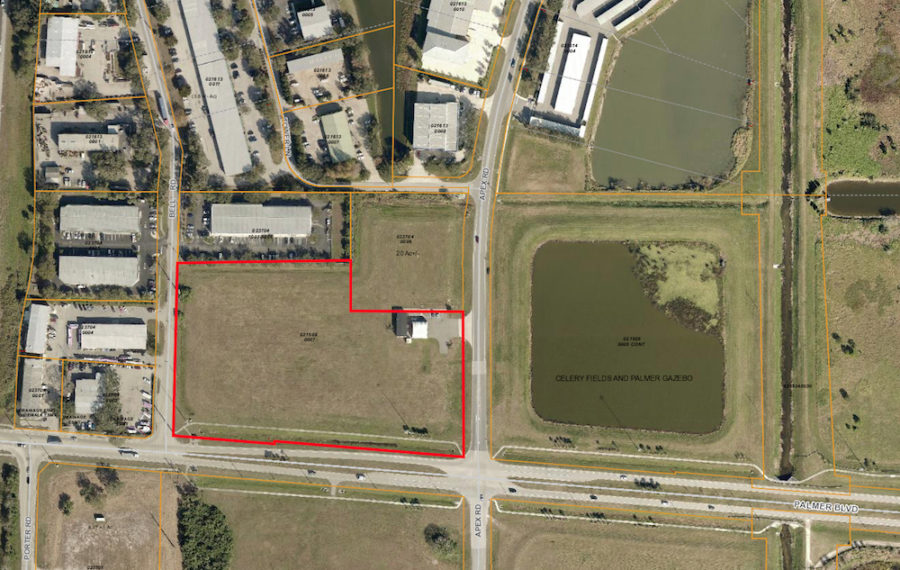
An aerial map shows the Northwest Quad outlined in red. Image courtesy Sarasota County Property Appraiser’s Office
Sarasota County Commissioner Paul Caragiulo won the unanimous support of his fellow board members this week to direct staff to begin analyzing the potential rezoning of a county-owned parcel near the Celery Fields as part of the Fruitville Critical Area Plan (CAP).
The vote followed commissioners’ expressions of conflicting viewpoints on the best use of what is known as the Northwest Quad, one of four parcels remaining from the creation of the Celery Fields stormwater project. A Miami consultant hired by the county to analyze the property said the “highest and best use” — a technical term regarding the greatest financial return to the county — would be as the site of 75,000- to 80,000-square-foot industrial facility. The firm estimated proceeds of $1.3 million to the county in the event the land were rezoned and sold for such a purpose.
However, in response to a question from Caragiulo, Eric Liff, a principal of Lambert Advisory, conceded that the firm did not take into consideration the constraints of the road network in the vicinity of the property.
“Did that come into play at all when you came down to the valuation?” Caragiulo asked.
“We’re assuming that through the development process, there are ways to mitigate [the traffic problems],” Liff replied.
Then Liff told Caragiulo, “That’s not taken into consideration in this analysis.”
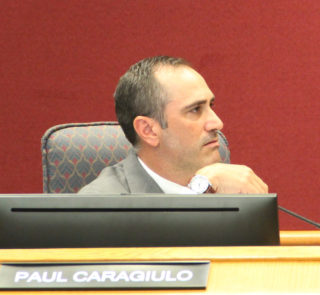
Commissioner Paul Caragiulo. File photo
“In this case,” Caraguilo said, referring to the area of Palmer Boulevard and Apex Road, “just about anything [except] a lemonade stand not seating more than five people” will lead to more traffic problems.
“That road can’t be widened,” Commissioner Charles Hines noted of Palmer Boulevard.
Chair Nancy Detert and Hines both talked about the potential of workforce housing on the Northwest Quad, while Commissioner Alan Maio pointed out that leaders of the Economic Development Corp. of Sarasota County have bemoaned the scarcity of property zoned for Industrial, Light & Warehousing (ILW) uses.
“I would not like to see any outdoor facilities that would result in pollution, such as concrete things flying around in the air,” Detert said of the Northwest Quad. “Metal recycling would not be good. … I would really prefer a recreational use, if possible.” However, she added that she would be agreeable to a warehouse with all uses contained inside that structure.
In reference to comments from people who had addressed the board at the beginning of its regular meeting on Oct. 10, Maio stressed, “We’re notgoing to hurt the Celery Fields, and no one here is prepared to do anything that impacts the new use that a stormwater [project] has evolved to.”
As Commissioner Michael Moran pointed out, many years ago, when the county was preparing to undertake the stormwater project that became the internationally renowned bird-watching area called the Celery Fields, the owner of the land insisted the county purchase the four adjacent “Quads” parcels.
Moran noted that the county’s intent always was to sell the Quads.
Before the Kimley-Horn and Associates consulting firm — in which he was a principal owner — created the Celery Fields at the county’s behest, Maio explained, “we had substantial in-structure, in-home intrusions of water during major events.”
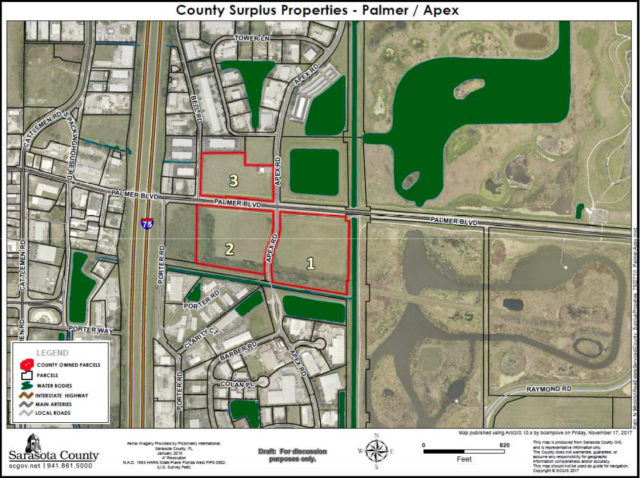
A graphic shows the three ‘Quads’ parcels (outlined in red) originally under consideration for sale as surplus land. The Southeast and Southwest Quads are not on the market, at commission direction. Image courtesy Sarasota County
Later, as Maio also pointed out, the Northeast Quad was devoted to construction of a retention pond that would make the other three parcels open for development without stormwater concerns, thus increasing their value.
“I don’t think there’s a reason to not use [the Northwest Quad] for something,” Maio added.
“Some folks in the public say, ‘Leave ’em all alone,” Hines said. “I disagree with that.”
Hines talked of his desire to sell the land because of the need to start building back up the board’s Economic Uncertainty Reserve Fund. Another recession will come, Hines pointed out, and the county is running out of the “rainy day” reserve that previous commissions set aside before the Great Recession.
Maio concurred with the need for the funds the sale of the Northwest Quad would bring. He indicated that comments he has made while campaigning for re-election have been misconstrued. The board approved balanced budgets for the 2018 and 2019 fiscal years, he said, without tax increases. Nonetheless, staff had put hundreds of hours into developing a surplus property list, because the county does need the revenue, he added.
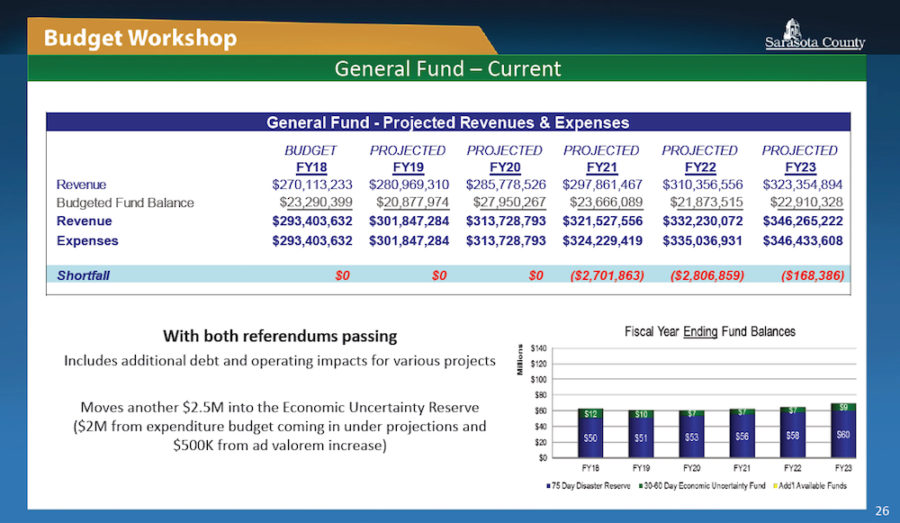
This is the Aug. 22 budget model showing the General Fund projections, factoring in passage of two state homestead exemptions on the Nov. 6 ballot. Image courtesy Sarasota County
“We’ve been very lucky with property value increases [the past few years],” Hines said.
Next steps
After Caragiulo made his motion, Matt Osterhoudt, director of the county’s Planning and Development Services Department, explained that the first step would be for staff to come back to the board with a proposal for the scope of work for inclusion of the property in the Fruitville CAP.
Commissioners emphasized that staff should not feel rushed to accomplish that.
“This isn’t an urgency thing that we need in two weeks,” Hines pointed out, referring to the previous day’s discussion about leasing county land at Nathan Benderson Park to Mote Marine Laboratory for a new aquarium. (See the related story in this issue.)
Maio suggested early January for the staff presentation. “Understood,” Osterhoudt replied.
In response to a Sarasota News Leader question, county Media Relations Officer Brianne Grant wrote in an Oct. 10 email that the work on the Northwest Quad is a two-phase project. The first was the economic and market analysis, which included the Lambert Advisory report. The expense of that phase was $33,695, Grant added.
The second phase will entail the necessary amendment to the Fruitville CAP and the rezoning, she continued, at a cost of $25,345.
Considering the potential uses
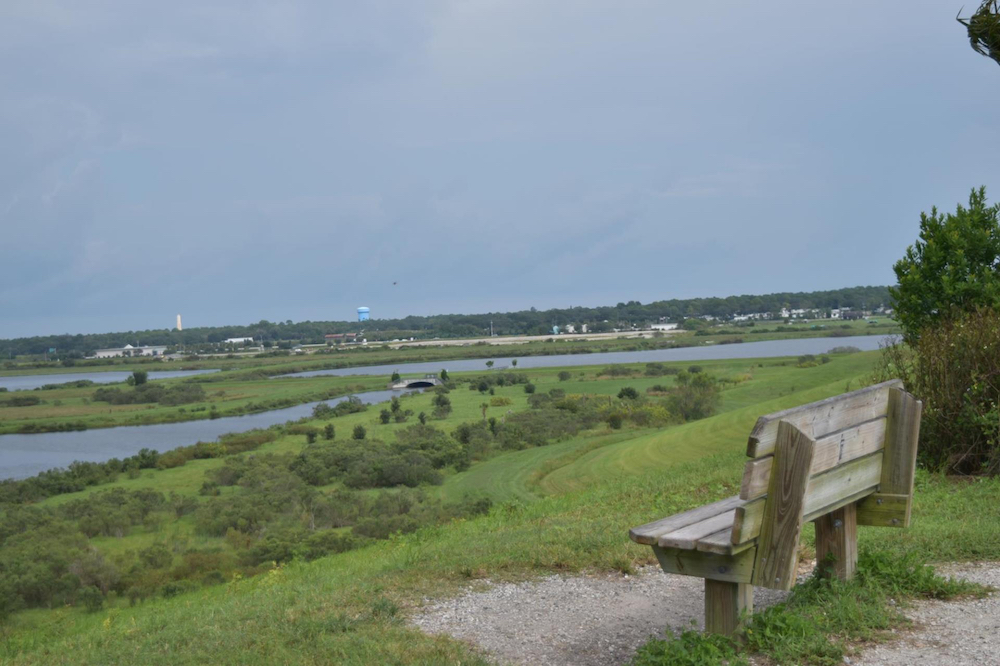
This is one vista of the Celery Fields in eastern Sarasota County. image courtesy Sarasota County
During a Nov. 28, 2017 budget workshop, Commissioner Maio won his colleagues’ support for the hiring of a consultant to consider the highest return on the Northwest Quad that the county could gain through the rezoning of the property. Lambert Advisory won the contract through a county-advertised Request for Proposals process, Maio pointed out on Oct. 10.
The commissioners concurred this week that they want any potential future buyer of the 7 acres available on the Northwest Quad to be certain of the zoning restrictions.
“Though office and residential opportunities comprise higher density development,” the firm’s report said, “their valuations are heavily impacted by the relatively narrow margin between the valuation of operating income and development cost.”
Lambert Advisory put the value of the Northwest Quad at $375,000 if it were to be used for a residential project; for office space, the value would be $150,000.
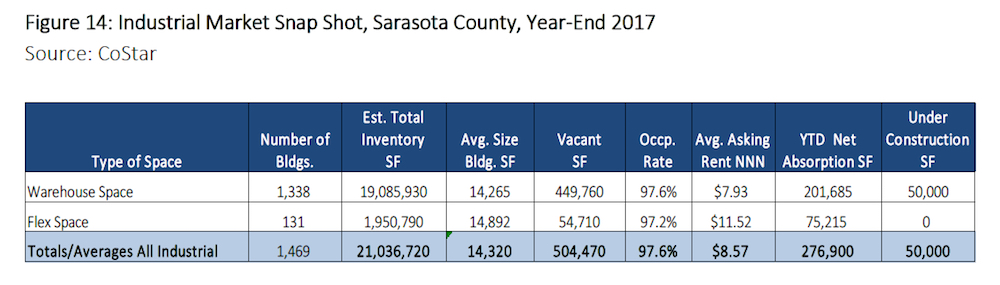
A chart in the Lambert Advisory report provides an industrial market snapshot for Sarasota County. Image courtesy Sarasota County
The report said the Northwest Quad appears to be able to support between 75,000 and 80,000 square feet of industrial development. “At this time, industrial development is the most compatible use relative to surrounding development,” the report adds.
In response to a question from Detert on Oct. 10, Liff explained that the definition of “highest and best use” is “the reasonably probable and legal use of vacant land or an improved property that is physically possible, appropriately supported, financially feasible and results in the highest value.”
Hines first broached the idea of workforce housing on the 7-acre site. (Another 2 acres of the parcel contains a manufactured building housing a fire station; it is scheduled to be replaced with a modern structure for firefighters and EMS crews. The design is underway, County Administrator Jonathan Lewis told the board.)
Hines also told his colleagues he was open to the idea of workforce housing on the Southwest and Southeast Quads.
“There’s a significant amount of jobs in this area,” Hines pointed out. Additionally, “You have a massive park that’s right there,” he continued, referring to the Celery Fields.
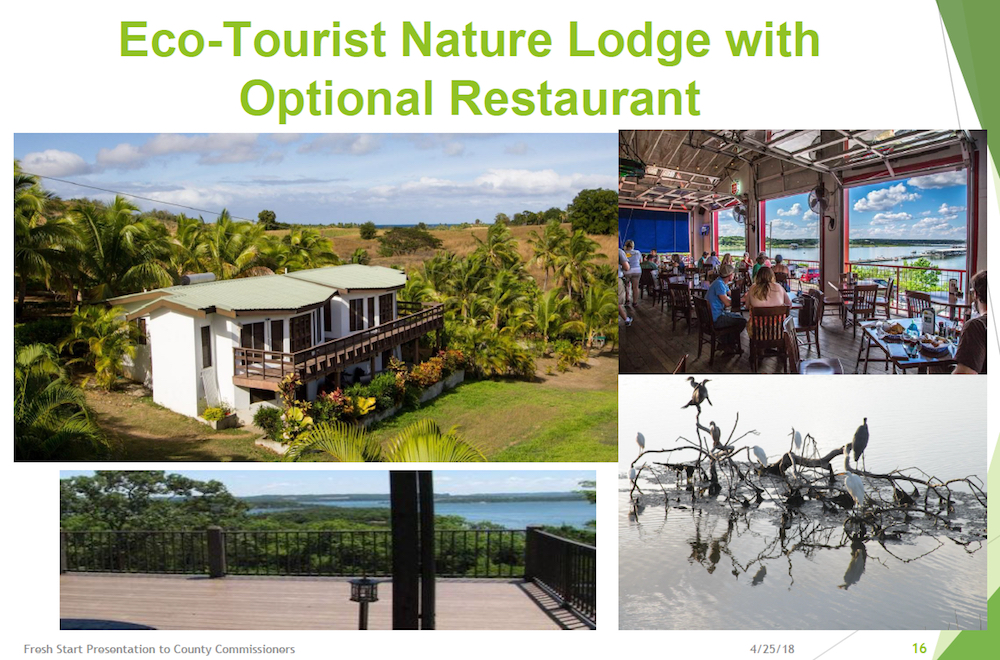
It has proposed recreational uses and perhaps a community center or ecotourism lodge on those other two parcels.
An ecotourism lodge has been one proposal of the Fresh Start Initiative. Image courtesy of the Fresh Start Initiative
Tom Matrullo, one of the Fresh Start leaders, pointed out during public comments on Oct. 10 that the commission already has approved six new housing projects that will entail 3,470 homes “within a short walk or drive from [the Northwest Quad] and the Celery Fields.”
“The Celery Fields is a pretty magnificent place,” Matrullo continued. “Many counties would consider themselves lucky to have it.”
“One thing I liked a lot [in the September Fresh Start presentation],” Hines said, was the potential of creative improvements to the Interstate-75 underpass to provide connectivity to Palmer Boulevard and the Celery Fields. A multi-family development on the Northwest Quad could take advantage of the walking and bicycling options, he added.
“I think that sounds great,” Detert replied.”
Another idea, Detert proposed, would be a combination commercial/residential development with amenities similar to those at Topgolf Tampa. That company’s website touts more than 100 “climate-controlled hitting bays,” a full-service restaurant and bars, private event spaces; a rooftop terrace with a fire pit; and more than 200 high-definition TVs.
“We should actually take advantage of the fact that the Celery Fields are there and continue along that recreational avenue,” she pointed out.
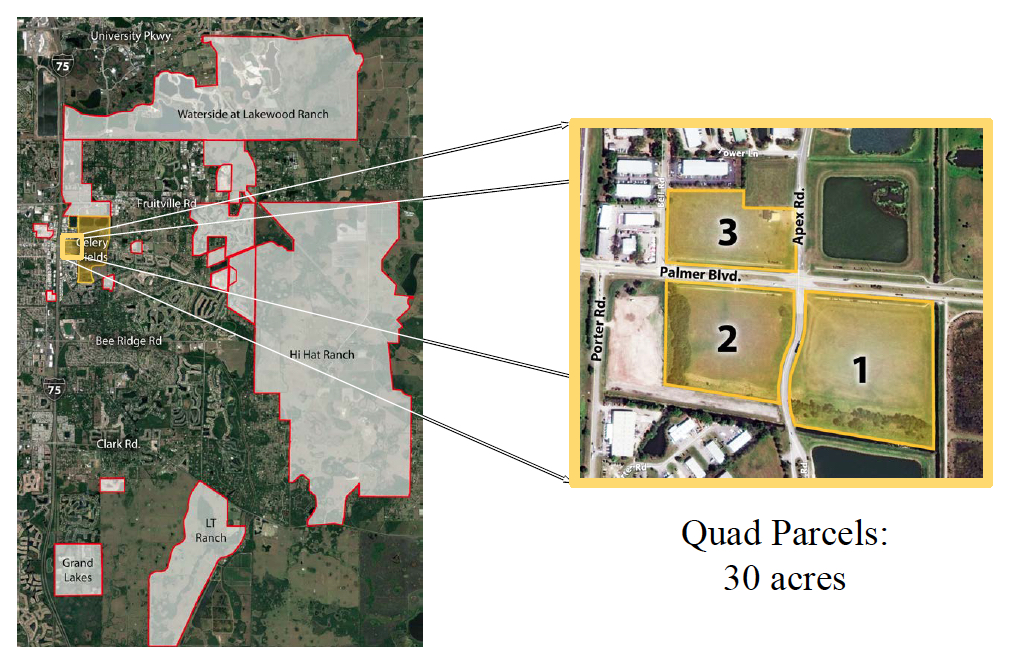
A graphic in the Fresh Start video shown to the board on Sept. 12 makes clear the location of the Quads. Image courtesy Sarasota County
When the commissioners asked about the uses available on the Northwest Quad now, Zoning Administrator Donna Thompson explained that the property is zoned Open Use Rural, which is devoted largely to agricultural uses. Through the special exception approval process, Thompson said, other uses could include a daycare center and a church, for examples.
Michele Norton, manager of the county’s Planning and Zoning Division, explained that any rezoning of the property would necessitate “reopening” the Fruitville CAP.
“I would be fine with having this rezoned to ILW,” Hines said. Multi-family housing and restaurants are among the uses allowed in such districts, he pointed out.
Noting the surrounding businesses, he added, “ILW’s compatible with everything that’s there.”
“I’m just not in any big rush to do anything here,” Commissioner Caragiulo told his colleagues.
Therefore, he continued, he felt an analysis through the CAP process would be appropriate.
The traffic issues have to be addressed, Caragiulo said.
The CAP analysis, Maio replied, “does more flesh out the details of the rezoning … what’s going to be required. “[Potential buyers] gotta know what they’re going to get.”
“I think that actually facilitates a little better community conversation,” Caragiulo said of utilizing the CAP process.
Quad parcel #3 is near the Celery Fields, not far from an elementary school, surrounded by thousands of new housing units you have recently approved. It’s owned by the public.
Last year, when two developers tried to buy and industrialize these public lands, you saw -- and heard -- heartfelt public opposition.
Now that the Board itself is playing the role of industrial developer, people will naturally ask why. They’ll want you to show that the proposed intensification will not endanger persons, property values, roads, or the community. None is in your paperwork for this discussion.
Does the lack of analysis mean that the public, who own this land, should not expect accountability, but instead just give you our trust?
Perhaps it’s difficult for you to offer a reason because this plan is not reasonable.
You have a letter from Fresh Start that summarizes numerous reasons why this plan and the study it’s based on are inadequate.
I have time for just one factor: You’ve approved six housing projects -- Worthington, Artistry, Sylvan Lea, Garden Village, Live Oak, and the Fruitville Initiative - a total of 3,470 new homes within a short walk or drive from parcel 3 and the Celery Fields.
At the same time, you’re seeking to allow an 80,000-square-foot industrial facility on parcel #3.
It’s as if you are seeing two completely incompatible versions of the same place at the same time. Just a few weeks ago, Mr. Waechter told you these fragile roads are already too full of dangerous large trucks to allow for a simple public park. Well how much more dangerous will they be after all the new homes are built, along with the 80,000-square-foot industrial facility?
What you in fact are planning is a slow motion car wreck -- a collision of industry and human lives that will imperil people, property, and community.
This can happen when you blind yourself to the larger picture.
At the same time, you’ve made no provision for the Celery Fields. It’s a pretty magnificent place, which many counties would consider themselves lucky to have. It needs some simple things -- parking, a shaded cafe, an exercise area.
Last month Fresh Start respectfully proposed that the Board dedicate the Celery Fields Quads to beneficial public uses in perpetuity
It’s a good plan. Stop this effort to put industry that no one wants in a place it no longer belongs. Stop it today, forever. Your communities, tourists, our children and 225 species of highly discriminating birds will thank you.
-- Tom Matrullo
After hearing from the consultant and considerable discussion, the Board of Sarasota County Commissioners agreed to direct staff to study reopening the Critical Area Plan for the Quad Parcels for possible modifications, and to come back after Jan. 1, 2019.
To: The Board of Sarasota County Commissioners
Re: Fresh Start statement in response to Lambert assessment industrializing parcel #3
Date: October 8, 2018
On Wednesday morning, Oct. 10, 2018, you will discuss an outside consultant’s recommendation to rezone a public parcel at Apex Rd. and Palmer Blvd. to industrial use.
As many are aware, Fresh Start has engaged in a nine-month dialog with the Board and staff regarding the fate of public lands in the Celery Fields Area. Yet despite this effort at mutual understanding, key questions remain unanswered.
Some of these questions specifically concern the recently completed assessment by your consultant, Lambert Advisory LLC -- an assessment based on spreadsheet comparables to the exclusion of real world considerations, such as road conditions or community values.
Other questions concern larger issues of planning and policy which lie at the root of land stewardship at this critical moment in the development of Northeast Sarasota County.
Take Surplus Land Policy for example: Before all else, why sell public land? Once sold, it’s gone forever. Neither the Lambert assessment nor the staff briefing states any reason why it benefits the community to sell this land.
Piecemeal planning: You have plucked one parcel (#3) from a complex interconnected area in transition and are seeking to rezone it for industry -- a use appropriate to 1983 -- without a glance at the larger relevant context. Fresh Start spent 9 months attempting to paint this larger picture from the residents' perspective. As stewards of our public lands, what proactive vision is guiding you now and for the coming explosion of development in East Sarasota?
MEC and Industry: Lambert Advisory's blunt determination that "industry" -- with no qualification as to what sort of industry -- would bring the highest price for parcel #3 is at odds with market activity at the Fruitville Initiative. That nearby area has more than 200 acres, all of which, like parcel #3, are designated MEC, but there appears to be no demand for industry. Various plans submitted to the County for the Fruitville Initiative are all multi-family residential. Given that these property owners presumably are marketing their properties to the highest and best use, there seems to be a significant disconnect between the reality created by the Lambert report and what's actually occurring on the ground. The Lambert finding warrants rigorous review and reconciliation to assure that the return on the public’s investment is not being short-changed.
Scoping task #4: Fresh Start asked to communicate with Lambert while the Consultant was doing its research. County staff opposed any communication:
Out of an abundance of caution to the process, I would not be comfortable with a private group directly communicating with a consultant on an item that will culminate in a quasi-hearing on a Board directive that was decidedly different from your own. (Email from county planner to Fresh Start dated 7.2.18).
How did this sidelining of the community advance the consultant’s task, which was to base findings on "a general understanding of the community and its residents"? (Scope #4).
Actual Road Conditions: Road conditions were the largest factor in last year's hearings concerning proposed industrial uses on parcel 2. To an inquiry from Fresh Start as to what information the County provided to Lambert regarding roads and traffic, the Lambert researcher replied:
At the time of the study, we were not aware of any documented issues related to development constraints, including roadway capacity.
Why was essential data about the fragile road situation on Palmer Blvd. and Apex Rd not provided to the consultant?
The Board expressed concern about road conditions on Sept. 12 when Fresh Start discussed light recreational and civic uses on these parcels. Where’s that concern now?
Foregrounding Industry: Anyone driving along Palmer Blvd. and Apex Rd. would not know there are small industrial and office parks nearby -- they are hidden by landscaping, by Ackerman Park, and by office buildings. Rezoning parcel #3 for industry redefines the character of the area -- from open space rural to industrial -- the very thing residents area have strongly opposed since January 2017.
Domino Effect: If parcel #3 goes to industry, parcel #2 will be surrounded by industrial uses on three sides. Mr. Gabbert's waste transfer station is already in the works for the six acres along the west side of parcel #2; Robert Waechter owns warehouses screened by trees immediately south of it. How long will it take before someone proposes that it “makes sense” to rezone parcel #2 for industry?
Irreparable damage
For these good reasons and more, Fresh Start opposes Sarasota County's rezoning and sale of any of our public lands at Apex and Palmer to private industrial developers. Approving industry here will compromise everything that planning is supposed to be about: Optimizing road safety, environment, community resources, aesthetics and economic value.
Sarasota has long enjoyed a reputation as one of the rare counties that's met developers seeking uncontrolled growth with intelligent restraint, a sense of design, and an awareness of tradition.
As our nine-month effort has made clear, many commonsense, beneficial alternatives exist for these public parcels. We urge you to respect this place of birds, fresh air and open space -- respect this unique place and the people from near and far who love it.
While the Celery Fields area itself lacks sufficient parking and complementary amenities such as a place for a bite to eat, where are the County’s plans for those real needs? Instead you are spending tax dollars to rezone a public parcel without a buyer in sight, or any industrial proposal on the table.
On Sept. 12 Fresh Start respectfully asked that you adopt a basic resolution:
To dedicate the Celery Fields Quads to beneficial public uses in perpetuity;
To actively seek and formally approve uses for these lands only after completing careful study of trending markets and opportunities; and
To invest in a plan that realizes the community’s vision.
We remain steadfast in supporting this course of action.
If you go forward with this rezoning, Sarasota will be known as the place where, over the unequivocal opposition of its citizens, the Board compromised the safety, the environmental health, and the future prospects of a pristine 360-acre birding sanctuary, recreation, tourism and residential area.
Sincerely,
Glenna Blomquist, Carlos Correa, Tom Matrullo, Gary Walsh
Executive Council for the Fresh Start Initiative
From November 2017 to September 2018, Fresh Start invested well over 1,000 volunteer hours gathering ideas, community support, and expert perspectives on the Celery Fields Area. Its July report is here. A "big picture" presentation is incorporated in this report, which was presented to the Board on Sept. 12. 2018 in video format. More about the Lambert Advisory report here and here.